Epson I3200 UV flatbed vs. Mimaki-class flatbeds: where ROI really changes
A practical, shop-owner comparison of factory-direct Epson-head UV flatbeds and premium-brand systems. The real question is not which logo is stronger. It is which machine your orders can pay back fastest.
The real comparison is payback, not prestige
When a print shop compares an Epson I3200 UV flatbed with a Mimaki-class flatbed, the conversation usually starts in the wrong place. People argue about brand prestige, dealer familiarity, brochure resolution and the comfort of buying a machine everyone has heard of. Those things matter, especially for a shop that cannot tolerate downtime or does not want to learn a more hands-on maintenance rhythm. But they are not the whole buying decision. For many growing U.S. print businesses, the stronger question is simpler: how many profitable jobs does this machine need to print before it has paid for itself?
A premium UV flatbed can be the correct machine. Mimaki has a mature dealer network, documented workflows, strong application history and a trusted place in sign, promotional and industrial printing. Epson.Press is not built around pretending that a factory-direct Epson-head printer is the same buying experience. It is not. The advantage we focus on is different: lower first-machine exposure, widely used Epson-head architectures, open consumable strategy, and enough practical capability for shops that want to bring UV work in-house before committing to a much larger equipment stack.
That distinction matters because UV printing is often purchased as a growth engine. The buyer is not only buying a printer; they are buying the ability to quote acrylic signs, golf balls, awards, packaging mockups, decorated panels, drinkware wraps, wood boards, event merchandise and short-run branded products without sending every order to an outside vendor. The machine becomes attractive when the owner can see a path from current demand to in-house margin. A lower capital cost makes that path shorter, but only if the printer is matched to sellable work and maintained correctly.
A factory-direct machine is not automatically better. It is better when the lower capex, open consumables and serviceable parts create a faster route to profitable in-house production.
What current market signals say about the gap
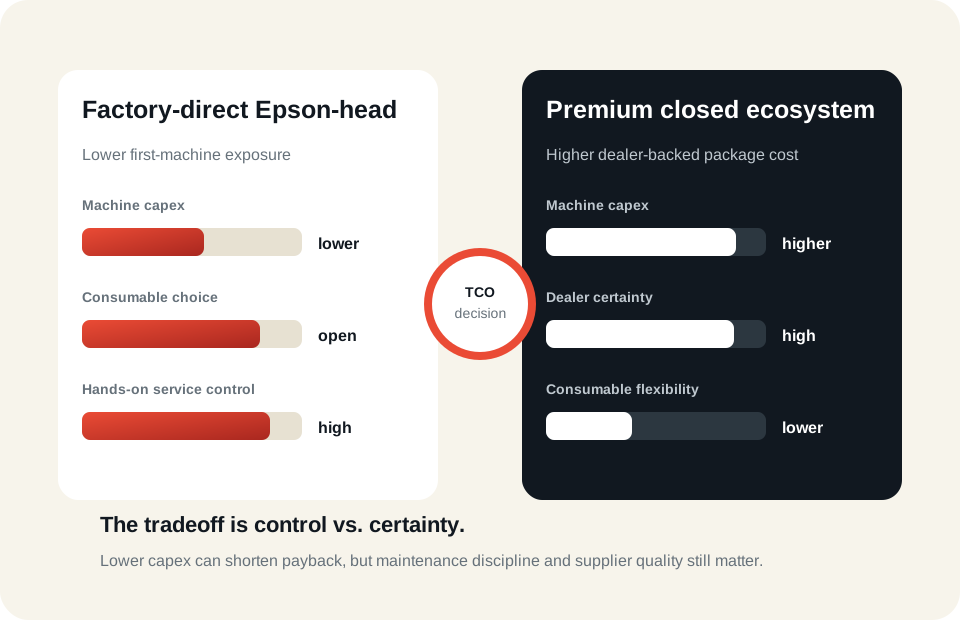
The buyer is choosing between control and certainty. The right answer depends on workload, skill level and cash flow.
Public pricing is messy because printer quotes depend on head count, bed size, ink set, software, freight, installation and options. Still, the market gives useful direction. Alibaba marketplace listings and sourcing pages for I3200 UV equipment commonly show entry desktop units in the low thousands, midsize professional flatbeds in the roughly $12,000 to $20,000 range, and larger or more automated systems moving above $25,000 before landed U.S. costs. Individual listings change constantly, and the number on a marketplace page is not a complete installed price, but it tells buyers why factory-direct equipment has become so tempting.
Mimaki-class machines occupy a different band. Official Mimaki pages and dealer-facing promotions show UJF tabletop and JFX flatbed systems positioned as premium, dealer-supported equipment. Public promotional material has shown small UV packages around the low-to-mid five figures and larger JFX packages at far higher levels once finishing bundles are included. That higher cost buys a more controlled ecosystem, brand confidence, dealer support and a documentation trail. It also raises the break-even point.
The ROI change happens because UV printing is a margin business. Suppose a shop sells acrylic signs, awards or drinkware work with $10 to $120 of gross contribution per order depending on product type. A machine that costs $15,000 to $25,000 before financing can be recovered by hundreds of good jobs. A premium package that lands several times higher may still be rational, but it usually needs a stronger pipeline, a faster machine utilization rate or a buyer who values dealer certainty more than the shorter payback path.
Buyer question
Factory-direct Epson-head answer
Mimaki-class premium answer
How much capital is tied up first?
Usually lower, especially for 6090, 9060, 1313 and UV DTF systems before freight and options.
Usually higher, especially once dealer package, installation and accessories are included.
Who owns maintenance discipline?
The shop and supplier must document head care, ink habits, spare parts and operator routine.
The dealer ecosystem carries more of the process and documentation burden.
How flexible are consumables?
Open platforms often allow more choice in ink, film, dampers and routine parts.
Consumables are more controlled, which can reduce uncertainty but limit price flexibility.
What is the best buyer profile?
Owner-operated shops, growing sign shops, personalization businesses and buyers comfortable with hands-on operation.
Higher-volume shops, corporate environments and buyers who prioritize dealer certainty over entry cost.
What is the risk?
Poor supplier selection and weak maintenance can erase the savings.
Higher capex can delay payback if the order book is not ready.
Why acquisition cost matters so much in the first year
The first year of UV ownership is where many purchases are won or lost. A shop is learning artwork preparation, jigging, substrate adhesion, white ink behavior, varnish settings, operator routine, humidity control, head cleaning and quoting. Even a strong operator will create waste while building profiles and product templates. The lower the capital exposure, the more room the owner has for this learning curve without every misprint feeling catastrophic.
This is why the cheapest printer is not always the best value. A machine that is underbuilt, undocumented or configured with the wrong head set can create downtime that costs more than the discount. The right factory-direct purchase is a balanced one: enough mechanics for the work, enough printhead capacity for the volume, enough support to keep the machine running and enough leftover budget for fixtures, spare parts, media testing and marketing. A budget spent entirely on the brand badge can be just as dangerous as a budget spent on the lowest listing price.
Think about a shop that wants to sell custom acrylic signs at $60 to $90 each. If the blank, ink, finishing and labor cost $25 to $35, the contribution per order may be around $30 to $55 before overhead. At 80 jobs per month, that could create $2,400 to $4,400 of monthly gross contribution. A $18,000 to $25,000 installed equipment scenario can begin to make sense. A much higher premium package may still work, but the shop needs either more volume, higher-priced jobs, or a stronger reason to pay for dealer-backed certainty.
The competitor comparison: where Mimaki still wins
A serious comparison has to admit where the premium machine wins. Mimaki systems are attractive because the buyer is not only buying metal and printheads. They are buying a recognized platform, dealer training, known media behavior, established software workflows, documentation, and a service route that many U.S. shops already understand. If a company has operators who change shifts, formal maintenance logs, corporate purchasing rules and little patience for experimentation, a premium ecosystem can be worth the additional cost.
Mimaki also has mature application knowledge around white ink, clear ink, primer, jigs and small object production. A tabletop UJF-style machine may not have the same printable area as a larger factory-direct flatbed, but it can be a polished solution for specific high-value object work. Larger JFX systems serve a different class of buyer again: sign and industrial print environments that expect a dealer relationship and have enough volume to justify the spend.
The Epson-head factory-direct argument is not that premium systems are weak. The argument is that many shops do not need to start there. If the buyer is testing UV demand, moving outsourced work in-house, building a local personalization offer, or adding rigid printing to a sign shop, the first machine should often be sized to the opportunity rather than to the dream version of the business. That is where a practical I3200 or I1600 platform can be financially powerful.
What makes the Epson I3200 architecture attractive
Epson's public I Series information describes the I3200 and I1600 families as PrecisionCore MicroTFP printheads used across aqueous, UV/eco-solvent and related industrial applications depending on model. The I3200 family is widely referenced because it offers 3200 nozzles, compact alignment, and a broad supplier ecosystem. The I1600 family is often used where the machine is narrower or more focused. This matters because a buyer is not betting on a rare printhead nobody can source. They are buying into a widely used architecture with a large parts and knowledge base.
That does not mean every head, board, ink system or waveform is equal. Genuine heads matter. Ink compatibility matters. Good dampers, clean capping, proper white ink circulation or agitation, and stable electronics matter. The printhead is only one part of the system. But the popularity of the I3200 class is one reason factory-direct UV machines can be priced aggressively and still support real production when the rest of the build is chosen carefully.
For buyers, the practical benefit is replacement planning. Printheads are consumable risk in every inkjet environment. A shop that understands head cost, replacement availability and maintenance discipline can build a realistic service budget. A shop that treats heads like magic parts that never fail will be disappointed by any brand. Epson.Press positions the head conversation early so a quote includes the boring details that protect uptime.
Consumables: where open platforms can lower job cost
UV printing profitability is not only about the machine price. The daily economics are ink, film, coating, primer, cleaning fluid, capping parts, dampers, waste, mistakes, labor and operator time. Open platforms can help because owners can often compare consumable suppliers instead of living inside one closed channel. This can lower the cost of experimentation, sample production and heavy-coverage effects such as white ink and varnish.
The danger is that cheaper consumables can become expensive if they create clogs, adhesion failures or color instability. The right way to use an open platform is not to buy the cheapest bottle. It is to build a controlled consumable set: proven UV ink, documented cleaning fluid, known film for UV DTF, tested substrates, maintenance routine and a record of settings that work. When the shop does that, lower consumable cost can translate into more aggressive quoting and more willingness to sample profitable jobs.
This is especially important in promotional products and custom merchandise. A buyer may want one-off samples, small batches and fast local turnaround. If every test print feels too expensive, the shop stops experimenting and loses sales. If ink and maintenance are affordable enough to test responsibly, the shop can discover products that competitors outsource or avoid.
Cost bucket
Why it matters
How to manage it
UV ink
Heavy white and varnish can drive product value but also increase cost.
Track ink per product family and price premium effects separately.
Film and adhesive
UV DTF jobs include transfer media, not only ink.
Quote wraps and labels with film cost visible in the model.
Printheads
Head failure can wipe out a month of margin if ignored.
Keep maintenance logs and build replacement risk into pricing.
Misprints
Small object work can lose money through rejects.
Use jigs, test templates and preflight checklists.
Operator time
A slow setup can cost more than ink.
Standardize repeat products and batch similar jobs.
A simple payback scenario
Use a realistic example. A shop buys a 9060 or 1313-class UV flatbed and lands the machine, freight, starter consumables and setup support at $18,000 to $25,000. The shop sells a mix of acrylic signs, awards and small branded panels. Average selling price is $55. Average blank, ink, finishing and labor cost is $24. Contribution per order is $31. At 100 orders per month, the machine creates about $3,100 of gross contribution before overhead, ads and waste. If the shop models $900 per month for paid acquisition, maintenance and rejects, net contribution is around $2,200. Payback on a $22,000 machine scenario is about 10 months.
Now change only one variable: the same shop buys a premium package that lands at $65,000. With the same product mix and volume, the payback period moves toward 30 months. That may still be acceptable if the premium machine reduces downtime, wins bigger accounts, improves automation or carries financing that fits the business. But it is not the same risk. This is why the lower-capex Epson-head approach matters for first-machine buyers.
The opposite is also true. If a shop only sells 15 small jobs per month, even a low-cost printer can be a mistake. The machine does not pay for itself because it is affordable. It pays for itself because the shop can feed it jobs with healthy contribution. Epson.Press uses payback modeling before quoting because the honest answer may be a smaller machine, a different platform or a delay until the product pipeline is stronger.
What to ask before buying any UV printer
The strongest buyers ask operational questions, not only spec questions. What products will be printed in the first 90 days? What is the largest repeatable size? How many jobs per week are already being outsourced? Does the shop need white ink daily or only occasionally? Are products flat, curved, flexible or irregular? Is the operator comfortable with daily maintenance? What happens if a head needs replacement? Where will the machine sit, and how will boards, bottles or rolls move through the room?
The machine class should follow those answers. A small object shop may be better with a vision-positioned flatbed or UV DTF platform than a large bed. A sign shop with boards and banners may need hybrid UV or a roll printer plus flatbed. A trophy shop may care more about fixtures, repeatability and white ink than raw speed. A startup seller may need a lower-cost F1080 or TX800 class machine to validate demand before stepping into I3200 production.
Ask for final landed cost, not only machine price.
Ask what printheads are installed and how replacement is handled.
Ask what ink set is recommended for your substrates.
Ask how white ink is maintained when the machine is idle.
Ask what spare parts should be ordered with the printer.
Ask for a sample on your actual product, not only a glossy catalog sample.
Bottom line for U.S. buyers
If you already run high-volume UV work and need maximum dealer certainty, Mimaki-class equipment may be the right purchase. If you are entering UV, bringing outsourced work in-house, selling custom hard goods, or trying to build a profitable local product line without tying up premium-brand capital, an Epson-head factory-direct machine deserves a serious look. The ROI changes because the first hurdle is lower and the consumable strategy can be more flexible.
The responsible way to buy is not to chase the cheapest listing or the most famous logo. Build the revenue model first. Choose the product category. Estimate monthly jobs. Price ink, blanks, labor, waste and service. Then choose the machine that gives you enough capacity with the shortest honest path to payback. That is the Epson.Press approach: practical equipment, documented assumptions and a quote built around the work you actually plan to sell.